Forged vs Cast Tent Stakes: Why Forging Makes a Tougher Stake
A tent stake spends its working life being hammered into ground that fights back, levered out again, thrown in a van and driven somewhere harder the following weekend. Whether the steel was cast in a mould or worked under a hammer is one of the things that most affects how well it survives that life — and the reason sits in the structure of the metal itself.
What casting gives you — and what it doesn't
Casting is one of the simplest ways to put steel into a shape: melt it, pour it into a mould, let it cool. For complex shapes made in volume, it is often the practical choice, and plenty of everyday metalwork starts and ends that way.
The catch is what the steel looks like on the inside when it comes out of the mould. As molten steel solidifies, its crystals — metallurgists call them grains — grow large and uneven, and small internal flaws can form as the metal shrinks and settles. Nothing has worked the metal; it has simply frozen in place. Coarse-grained, as-cast steel tends to be more brittle than the same steel after working: a crack that starts has a longer, easier path to follow through big grains.
Under a steady, static load, that can be perfectly acceptable. Under repeated impact, though, unworked steel with coarse grains or casting flaws is usually far less forgiving than steel that has been properly worked. This is why steel mills work almost everything — rolling, forging, drawing — before it becomes a finished component. An as-cast billet is a starting point, rarely the product.
What forging does to the same steel
Forging shapes hot steel by squeezing or hammering it. Picture pressing down on a block of modelling clay: it isn't only the surface that moves — every part of the inside shifts to let the block change shape. Hot steel behaves the same way under a forging press or hammer, and that internal movement is where the improvement happens.
Each pass of work breaks up the coarse as-cast grains. Given enough work and the right heat, the steel then does something remarkable: the deformed crystals reform as fresh, strain-free grains — a process called recrystallization. Worked, allowed to recover, and worked again under control, the grain structure can be progressively refined. Finer grains generally mean tougher steel — a crack has to keep changing direction at every grain boundary, losing energy as it goes.
For anyone buying steel products, chemistry is only part of the story. Two components can be made from identical steel and perform very differently, because a large part of a steel's final character comes from how it was worked — how much, how hot, and in what sequence.
Grain direction — the part cutting can't fix
Worked steel bar has a grain flow, a directionality running along its length — loosely comparable to the grain in a length of timber. Anyone who has split firewood knows wood gives way easily along the grain and resists stubbornly across it. Steel is subtler, but the principle carries: a stake's grain runs the length of the bar, and every load it takes meets that grain one way or the other.
Cut or machine a point onto a bar and you slice straight across that grain flow — the fibres are severed exactly where the stake takes its hardest punishment. Forge the point instead, and the grain follows the shape, flowing continuously down into the tip rather than being cut off at it. A component whose grain flow follows its contours stands up to impact and repeated loading better than one whose grain has been cut through.
This is one reason forged components have long been preferred for parts that get hit, levered and loaded for years. The shape may look identical from the outside; the inside is a different material story.
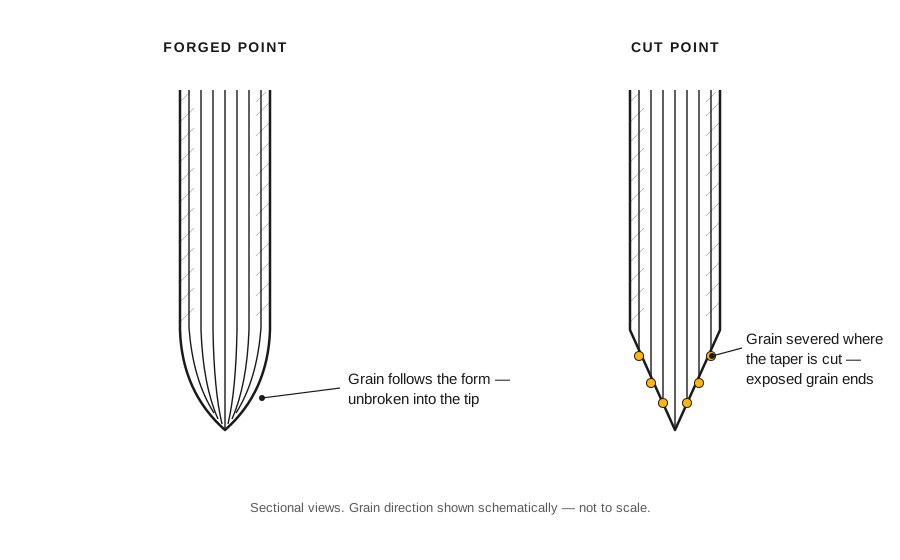
Cutting or grinding a point onto bar stock is a common, cheaper way to make a stake, and you'll see plenty of stakes made that way. It runs straight into the grain problem above: a cut point crosses the grain instead of running with it, so the tip tends to give up strength exactly where a stake takes its hardest punishment. That's not a case against cut points for lighter-duty use — it's why a forged point starts from a stronger place.
What this means for a stake's working life
Across a season, a professional stake is driven and extracted hundreds of times, often into compacted or stony ground. Two properties do most of the deciding about how it copes. The point needs hardness — the ability to hold its geometry under concentrated impact instead of mushrooming or deflecting. The shaft needs toughness — the ability to absorb abuse without cracking. Hardness and toughness pull against each other in steel — and the clearest example is what happens after hardening. Quenched steel comes out of that step at its hardest and, in that state, at its most brittle. Tempering — a controlled reheating step afterward — is what pulls some of that hardness back in exchange for toughness; tempering temperature is effectively the dial a manufacturer turns to land at a specific point on that trade-off. Getting hardness at the point and toughness through the shaft in one product is exactly that dial, applied with intent — not something an operator can fix on site.
What you're choosing, then, is not a steel that bends — it's a stake that has been made properly all the way through: forged so the grain runs with the form; hardened by the right heating, quenching and working for its grade; and then tempered, taking back just enough of that hardness so the steel won't shatter under impact yet stays hard enough to hold its shape in service. A stake made that way absorbs far more stress before any bend or break occurs — that threshold is the point of all the manufacture above — and it drives straight in and comes straight out, season after season. On the rare day something exceeds even that, it bends where a badly made stake snaps, in plain view at kit inspection. (If a stake has bent, retire it rather than straighten it — the metallurgy behind that, and why bent tips steer off line in the first place, is covered in Why Marquee Stakes Bend.)
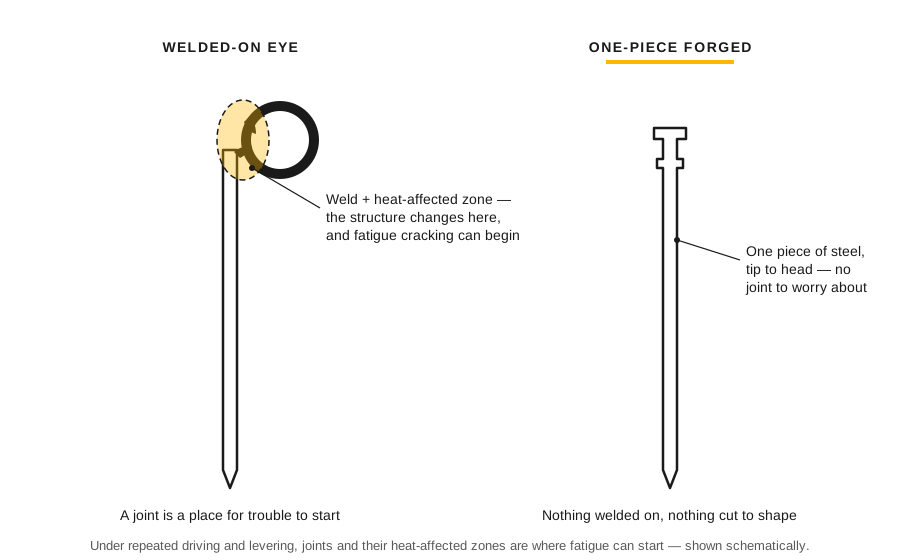
The same principle applies at the other end of the stake. Some tent stakes carry an eye, hook or bracket welded on separately rather than shaped in one piece with the shaft. Welding locally melts and fuses the joint and thermally cycles the steel around it, leaving a heat-affected zone whose structure differs from the metal either side of it. Under the repeated driving and levering a stake sees, that joint and its heat-affected zone are where fatigue cracking can begin. A component forged as a single piece, tip to head, has no such joint to worry about. Every Tiger Stake is exactly that: one piece of high alloy steel, forged end to end — nothing welded on, nothing cut to shape, nothing cast.
And whatever the steel, holding power is proven on site, not in the brochure — how to conduct a pull test covers the method.
A steel made for one job
If you want to see how much design goes into a modern steel, the video below is worth anyone's time — it follows a new alloy from recipe sheet to worked bar, and shows how small adjustments to composition and processing produce a steel matched to one purpose.
Watch: A new steel alloy being designed and made — from recipe sheet to worked bar.
That is exactly the thinking behind the steel in a Tiger Stake: a high alloy steel created specially for Hogan — a recipe of their own, manufactured for one job, tent stakes of the highest quality — and refined over decades of making them. The patented heat-drawn point puts the finishing detail on it, which is why the point that goes into hard ground comes out ready for the next job.
Frequently asked questions
Are cast tent stakes weaker than forged ones?
As a general rule, for anything that lives under a hammer, yes. Cast steel of the same composition tends to have a coarser, less uniform grain structure than forged steel, which makes it more brittle under impact. Forging refines the grain and aligns it with the shape of the component, which is why forged products generally cope better with the repeated driving and extraction a professional stake sees.
Why is it better for a stake to bend than snap?
The bigger difference comes first: a properly made stake absorbs far more stress before any bend or break occurs, and drives straight in and out season after season. If something does finally exceed that threshold, a bend announces itself — it shows up at kit inspection and the stake is retired — while a brittle stake can fracture suddenly under load, and a failed anchor under a tensioned structure is a safety problem, not a kit problem.
How are Hogan Tiger Stakes made?
Tiger Stakes are made in the USA by Hogan Manufacturing, who have been making premium tent and marquee stakes since 1948. They are produced from high alloy steel — a recipe created specially for Hogan — with a patented heat-drawn point. The range runs to eight sizes, from 18" × 5/8" up to 60" × 1.125". If you want to talk through which size suits your structures and ground, get in touch.
Talk to Hogan
If you're weighing up a stake inventory and want a straight conversation about steel, sizes and ground conditions — no hard sell — get in touch. We're happy to advise, whether or not Hogan stakes turn out to be the right fit for your operation.
Email: hoganuk [at] hoganstakes.co.uk
Contact form: hoganstakes.co.uk/contact
Product range: Tiger Stakes